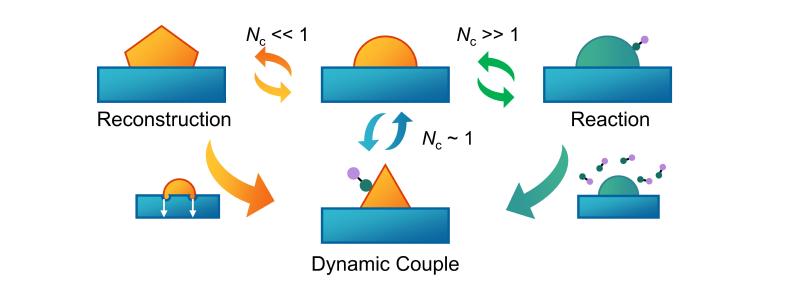
Cluster catalysts, which maximize atomic efficiency and expose a variety of low-coordination metal sites, have gained significant attention due to their potential in sustainable chemical transformations. However, these catalysts are inherently dynamic under reaction conditions, with adsorption reactions leading to continual restructuring and even the breaking of metal-metal and metal-support bonds, generating a range of metastable structures. This study identifies three distinct catalytic behaviors: flow, kinetic trapping, and coupling modes, and introduces a coupling descriptor, Nc (the ratio of structural rearrangement timescale to chemical timescale), to differentiate between these modes. The findings suggest that, under coupling mode, where the structural and chemical clocks are synchronized, the catalyst achieves maximum reaction rates while maintaining high stability. This research provides a systematic framework for understanding and optimizing the dynamic behavior of cluster catalysts, offering a predictive, quantifiable approach to enhance catalytic performance beyond traditional empirical methods.